Early failure usually starts with the installation environment or power supply, not the LED chips: trapped heat, dust, voltage excursions, generator transfers and incompatible fluorescent wiring all shorten service life. You will be able to separate a failed driver from a failed LED board, troubleshoot the circuit in the right order and compare replacement tubes using specifications that matter in Delhi offices.
Key takeaways
- Check heat, dust and supply voltage before replacing the tube.
- Disconnect and test the old fluorescent ballast before fitting an LED tube.
- Trace power from the circuit to the driver, board and connections.
- Choose a complete tube-and-driver assembly rated for the installation conditions.
Heat, dust and unstable power are the first failure suspects
Heat, dust and unstable power are the first suspects when LED tube lights fail early in Delhi offices. A closed false ceiling, hot slab or poorly ventilated ceiling void can make the driver and LED board far hotter than office air; a 25 °C life claim does not prove performance at 40–50 °C.
Dust and construction debris block heat transfer from the aluminium board and driver enclosure, while dust on the diffuser cuts delivered illuminance.
Delhi’s nominal supply is 230 V, 50 Hz, with about ±10% tolerance, so a wattage-only selection may see roughly 207–253 V. Voltage spikes after outages, automatic generator changeover, UPS waveform distortion, abrupt transfer transients, high source impedance, loose neutrals and shared air-conditioning circuits add stress. These are common LED tube light problems in Delhi.
Measure ceiling temperature and inspect ventilation and dust before blaming the lamp.
1. Record whether one fitting, one room, one circuit or every fitting is affected. Repeated failures on one circuit indicate a shared cause, not random tube mortality.
2. Check the MCB; isolate power; inspect terminals for looseness, heating, neutral discontinuity and damaged insulation.
3. With a qualified electrician, measure voltage at the luminaire while switched on during utility, UPS and generator operation.
4. Identify ballast or direct-mains wiring, then test the fitting on a known-good circuit.
5. If input power is correct but the lamp stays dark, inspect driver output, connectors and LED-board joints; a dark tube without blackened LEDs often has driver failure.
An old fluorescent fitting can damage or disable the replacement
An old fluorescent fitting can damage or disable an LED replacement when its wiring does not match the tube. That mismatch explains many led tube light problems in Delhi.
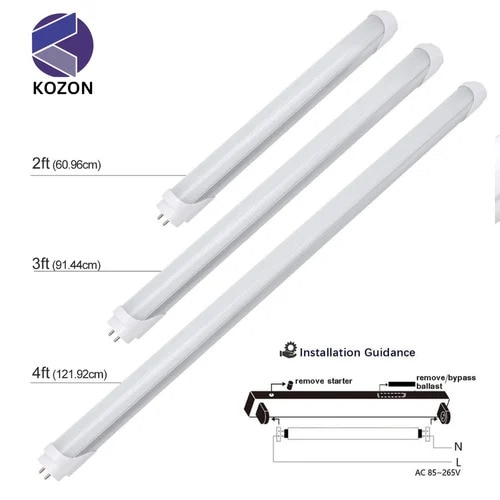
An integrated LED tube is a complete mains luminaire. A T8 retrofit tube may require a magnetic ballast, an electronic-ballast-compatible fitting, or direct mains after ballast removal; these are different products. Leaving a ballast connected to a direct-mains tube can cause flicker, excess loss, overheating or failure to start.
Before installation, check:
- Read the supplied wiring diagram and confirm whether the tube is single-ended or double-ended.
- Check whether the two pins at one end are internally shorted or separately connected.
- Identify whether a starter remains in the circuit.
- Verify the G13 or other lamp base, T5 or T8 diameter, terminal arrangement and earthing.
- Check for an emergency ballast, dimmer or occupancy-control output that could cause flicker or prevent starting.
Removing or bypassing a ballast without the specified diagram creates shock and short-circuit risks. Rewire and label the fitting instead of assuming the old starter position is correct. This check matters before specifying a commercial led tube light in delhi, because two tubes with the same diameter can require opposite connection methods.
Use a circuit-first sequence to find the actual failed part
Start by mapping the fault, not by replacing the LED batten light. Record whether the failure affects one fitting, one room, one circuit or every fitting; several failures together point to a shared supply or control problem.
1. Check the MCB and confirm whether it has tripped. Isolate power before opening the fitting, then inspect terminals for looseness, heat marks, neutral discontinuity and damaged insulation.
2. With a qualified electrician, measure voltage at the luminaire while it is switched on. Repeat the measurement on utility power, UPS output and generator supply; changeover transients and distorted generator waveforms can explain failures that appear random.
3. Identify the wiring before changing the tube. Confirm whether the fitting uses a magnetic ballast, electronic ballast, direct mains, or emergency-lighting equipment. A tube designed for direct mains can flicker, overheat or fail with a ballast left connected.
4. Test the fitting on a known-good circuit. If it works there, investigate the original circuit rather than ordering more tubes.
5. If input power is correct but the lamp stays dark, inspect the driver’s input and output, connectors and LED-board solder joints. A dark tube without blackened boards often has dried or vented electrolytic capacitors, a failed MOSFET, rectifier damage, cracked solder or surge damage in the driver.
6. Dark sections, colour shift and uneven output point toward LED-board or connection faults. If several tubes fail together, measure the shared neutral, supply waveform and switching equipment before replacing another lamp.
What 36W symptoms reveal about the driver and the specification
A flickering 36W tube does not identify a failed LED board: low-frequency driver ripple, a loose neutral, unstable dimming or occupancy-control output, generator waveform distortion, and an incompatible emergency ballast produce similar symptoms.
Phone-camera banding is a screening clue only; measure ripple or use a recognised flicker method such as IEEE 1789 guidance or IEC TR 61547-1.
| Symptom | Likely area | What to check |
|---|---|---|
| Flicker | Driver or supply | Ripple, neutral continuity, dimmer output, generator waveform and emergency ballast compatibility |
| Delayed start or repeated tripping | Driver or supply | Input voltage at the luminaire, driver components and changeover equipment |
| Buzzing | Magnetics or failing component | Driver vibration, loose parts and audible electrical noise |
| Dark sections | LED board or connection | Connectors, solder joints and board damage |
| Colour shift or rapid lumen loss | Thermal or current stress | Board temperature, driver-current stability and ageing |
Ask what “36W” means: LED-board input power, total fixture consumption or fluorescent-equivalent output. Compare rated input current, power factor, total harmonic distortion and delivered lumens at rated voltage; two products with the same label can load a circuit differently.
Treat “50,000 hours” as a lumen-maintenance claim, not an operating guarantee. Request LM-80 data, a TM-21 projection where applicable, driver survival information, switching-cycle limits and warranty conditions. These checks separate the search term “36w led tube light issues” into supply, driver, board and specification faults before you replace a tube unnecessarily.
Choose the complete tube-and-driver assembly for Delhi conditions
Choose the complete tube-and-driver assembly, not a wattage label, for a commercial LED tube light in Delhi. Match the replacement to the fitting and its power source.
| Option | Wiring and driver check | When it applies |
|---|---|---|
| Integrated tube | Driver is built in; follow the supplied single- or double-ended diagram | Replacing the complete luminaire |
| Ballast-compatible retrofit | Confirm the named magnetic or electronic ballast remains compatible | Keeping the fluorescent fitting |
| Direct-mains retrofit | Remove or bypass the ballast exactly as shown; identify driver location | Wiring the tube directly to supply |
Before ordering, confirm:
- Physical length, T5 or T8 diameter, G13 or another base, terminal arrangement and earthing
- Single- or double-ended wiring, allowable mains-voltage range and compatibility with the site UPS and generator
- Power factor, total harmonic distortion, surge withstand, operating-temperature range, beam distribution, colour temperature and ingress-protection rating
Do not accept a wattage-only quote. Ask for evidence covering IEC 60598-1, IEC 61347 and, where double-capped replacement lamps apply, IEC 62776, plus EMC immunity and emissions reports.
Inspect the ceiling void for heat, dust and moisture, then measure supply voltage at the luminaire during utility-to-generator transfer before buying a batch. Ask whether the driver is replaceable and obtain the replacement-driver policy.
Kozon India Solutions Pvt Ltd belongs in the comparison when it supplies these installation-specific details, not merely a nominal wattage or long-life claim.
Related products
 | Tube Lights (T-5 and T-8) ₹480 Brighten your indoor spaces efficiently with our T-5 and T-8 LED Tube Lights. View product → |
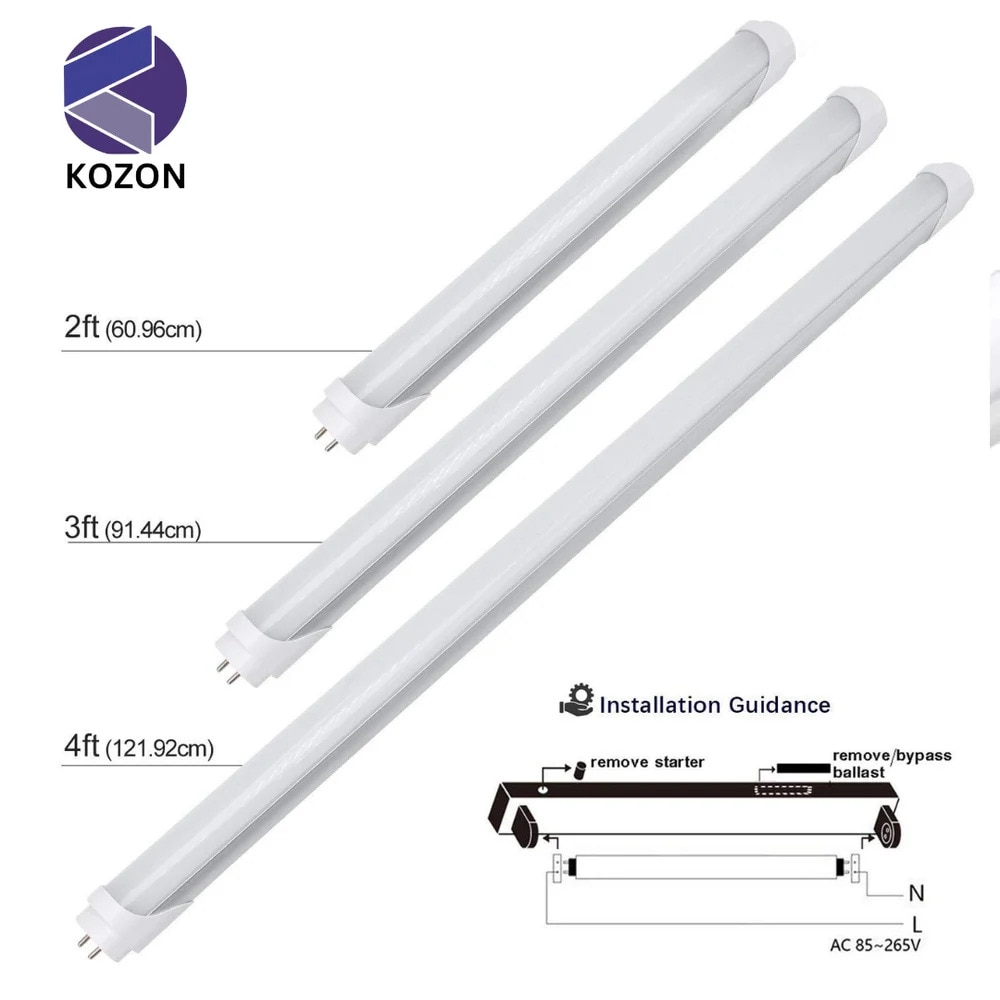 | LED Batten Light 18W Dimmable T8 Retrofit Tubelight ₹625 About this item ✔ ENERGY SAVING: Produces 1000 LUX equivalent to 24watt florescent bulbs. View product → |
Frequently asked questions
Why do LED tube lights fail early in Delhi offices?
Heat trapped above false ceilings, dust buildup and unstable power can overheat or damage the driver and LED board.
Can an old fluorescent fitting damage an LED tube?
Yes. A fluorescent ballast, starter or incompatible wiring can prevent the LED tube from starting or expose it to the wrong electrical conditions.
How do you troubleshoot an LED batten light?
Follow the circuit-first sequence: verify supply voltage, inspect connections, isolate the driver, then test the LED board and replace the failed part.
What do 36W LED tube light symptoms indicate?
Flickering, delayed starting, dim output or sudden shutdown can point to driver failure, overheating, poor connections or a mismatch between the driver and LED board.
Why choose a complete tube-and-driver assembly?
A matched assembly reduces compatibility faults and gives you a clearer specification for heat tolerance, electrical input and replacement.
Related product
 | LED Batten Light 4 Feet T8 Retrofit Led Tube Light ₹250 About this item ✔ ENERGY SAVING: Produces 1000 LUX equivalent to 24watt florescent bulbs. View product → |
Keywords