A 150 W high bay is not automatically suitable for a large warehouse: ceiling height, rack geometry, beam distribution and maintained lux determine whether it improves visibility or creates dark aisles and glare. By the end, you will be able to test a 150 W proposal against 100 W, 200 W and 250 W alternatives, compare it with older lighting, and request the documents needed for a reliable Delhi NCR installation.
Key takeaways
- Match delivered lumens and beam angle to mounting height and aisle layout.
- Request IES photometry, LM-79 data and a lighting simulation before installation.
- Choose 150W over 100W when spacing, ceiling height or target illuminance demands it.
- Check glare, heat rating, surge protection and maintenance access—not wattage alone.
Where a 150 W High Bay Fits in a Large Warehouse
A 150 W high bay light for warehouse use can serve open storage floors, loading areas and picking zones when its tested photometry matches the ceiling height, spacing and task. Wattage alone cannot confirm suitability: compare total luminaire input watts, delivered lumens, efficacy, beam distribution, glare, uniformity and rated ambient temperature.
A product sold as a 150w hibay light in delhi may perform very differently from another 150 W fitting.
| Area | Suitable use | When it becomes unsuitable |
|---|---|---|
| Open storage floor | Wide beam across regularly spaced fixtures | Dark patches appear when spacing exceeds the tested layout |
| Tall, narrow aisles | Narrow or aisle-optimised beam aimed along rack runs | Light spills onto racks or creates glare at forklift height |
| Picking or packing bench | Lighting designed for the required task and maintained lux | Faces and work surfaces remain dim despite a bright floor |
| Loading bay | High bay used with the actual dock height and layout | Open doors, shadows or vehicle canopies block the intended coverage |
| Inspection area | Fixture supported by the task’s required colour quality and uniformity | Surface defects remain hidden under uneven light |
Request the manufacturer’s IES or LDT file and model the actual rack heights, aisle widths, mounting height, fixture spacing, ceiling and wall reflectance, maintenance factor and required uniformity. Check calculated and measured lux at the floor, storage faces, picking benches, loading bays and inspection points.
Choose another wattage or optic when the calculation shows poor minimum illuminance, excessive glare, or wasted light on racks and walls. A 150 W fitting is unsuitable if it cannot meet the project’s maintained-lux target at the required mounting height.
How to Prove the Lighting Level Before Installation
A 150 W fitting is suitable only when its tested photometry produces the required maintained lux across the actual warehouse layout. Wattage alone cannot show whether light will reach floor aisles, rack faces or picking stations.
1. Request the complete-luminaire IES file under LM-63 or an equivalent LDT file, not a bare LED chip lumen figure. Check delivered lumens, beam angle, optical distribution, colour temperature, mounting-height data and glare rating. Use the tested file from the exact model, driver and optic.
2. Build a lighting calculation using ceiling height, aisle width, rack height, fixture spacing, floor and wall reflectance, and the planned mounting positions. Compare narrow-beam optics for tall aisles with wider distributions for open storage; the wrong beam creates bright spots, dark rack faces or wasted light on walls.
3. Set the target maintained illuminance from the task and project brief, then apply a maintenance factor for LED lumen depreciation, luminaire dirt and room-surface depreciation. A design that passes on initial lux can fail after dust accumulates.
4. Check average and minimum lux, uniformity, and glare at floor level, storage faces, picking benches, loading bays and inspection points. Confirm that forklift sightlines and labels remain readable; more wattage will not fix glare from an exposed high-output fitting.
5. After installation, measure a grid of points with a calibrated lux meter at the working plane and compare readings with the calculation. Record mounting height, spacing and measured values for acceptance.
This evidence demonstrates the industrial high bay light benefits in practice: usable illumination, fewer dark patches and controlled operating cost.
When 150 W Beats 100 W, 200 W or 250 W
Choose 150 W when its delivered lumens and beam pattern meet the maintained-lux target with fewer compromises than a lower- or higher-wattage fitting. Search terms such as 150w hibay light in delhi and 150w high bay light benefits ncr in delhi are not specifications.
| Option | Annual energy at 12 hours daily | Installation and decision check |
|---|---|---|
| 100 W | About 438 kWh per fitting | Lower consumption, but extra fittings may increase cabling, access work and glare points |
| 150 W | About 657 kWh per fitting | Compare its IES or LDT layout against mounting height, aisle width and required uniformity |
| 200 W | About 876 kWh per fitting | Extra output helps only if the calculation shows a genuine shortfall |
| 250 W | About 1,095 kWh per fitting | Higher running cost and glare risk; do not use wattage to correct poor spacing |
| Metal-halide, HPS or fluorescent | Use measured luminaire input, including ballast | Account for warm-up, relamping, heat, maintenance access and replacement quantity |
The 150 W and 250 W figures differ by 438 kWh per year per fitting on that schedule, before driver losses, controls and actual operating hours. Compare total input watts, delivered lumens, efficacy, beam angle, power factor and maintenance factor rather than the label alone.
Installation effort depends on the layout. A 100 W fitting that forces additional rows can cost more in lifts, cable runs and shutdown time than a well-spaced 150 W system.
Approve 150 W only when the photometric calculation shows floor and rack-face lux, uniformity and glare at the actual mounting height; otherwise choose another optic or fitting.
The Warehouse Risks Wattage Alone Will Not Solve
A 150 W fitting can meet the lux calculation and still create unsafe shadows, eye strain or excessive maintenance. Treat a high bay light for warehouse use as a complete system, not a wattage label.
| Risk | What to check | What goes wrong if ignored |
|---|---|---|
| Glare | UGR result, lens brightness and viewing angles from forklift seats, picking benches and aisles | Bright LEDs in the driver’s sightline cause discomfort and reduce visibility |
| Flicker | Driver data for flicker percentage and stroboscopic effect, especially with cameras or moving machinery | Unseen modulation can cause headaches, camera banding or a dangerous strobe effect |
| Heat | Complete luminaire input watts, rated ambient temperature, heat-sink clearance and driver location | A hot ceiling zone accelerates lumen depreciation and driver failure |
| Dust | IP rating, sealed lens, fin geometry and access for cleaning | Dust on the lens cuts output; dust-clogged fins trap heat |
| Controls | Sensor coverage, dimming protocol, zoning, inrush current and emergency-lighting compatibility | Sensors leave aisles dark, or incompatible drivers waste energy and create nuisance switching |
| Maintenance | Driver and LED-module replacement method, lift access, cleaning frequency and spare availability | A low-priced fitting becomes expensive when every repair requires warehouse shutdown |
Check the lens and heat sink as maintenance items, not just purchase specifications. Compare the delivered light after the maintenance factor, and confirm aisle coverage at the actual rack height and spacing. A wide beam can waste light on racks; a narrow beam can create bright spots across open storage.
What to Request from a Delhi NCR High Bay Supplier
Do not approve a quotation until the supplier provides project-specific evidence, not a catalogue claim. A listing for a 150W hibay light in Delhi is only a search label; compare total input watts, delivered lumens, efficacy, beam distribution, mounting height and maintained uniformity.
Request these items from every shortlisted high bay light manufacturer in Delhi:
- An IES or LDT photometric file and a warehouse layout calculation showing average and minimum lux, uniformity, glare, aisle coverage and maintenance factor.
- The complete-luminaire test report, not only LM-80 or TM-21 data. Ask for L70 or L90 life tied to a stated ambient temperature and thermal test condition.
- The driver’s make, model, power factor, total harmonic distortion, surge rating and flicker measurement method.
- The warranty document, including exclusions, replacement procedure, response time and availability of spare drivers.
- Product identification, batch traceability, IP rating and the rated ambient-temperature range.
| Check | What to compare | Reject if |
|---|---|---|
| Electrical | Total luminaire watts, power factor and THD | The seller gives LED wattage only |
| Photometry | Beam angle, delivered lumens and tested file | The file does not match the quoted model |
| Reliability | Thermal rating, life statement and warranty | Life is stated without temperature or conditions |
| Supplier support | Sample inspection, references and spare-driver plan | No identifiable service contact exists |
Ask Kozon India Solutions Pvt Ltd to identify the exact driver and photometric file for the quoted model; do not accept a different file for a similar-looking fitting. Compare one installed sample at the proposed height before releasing the full order.
Related products
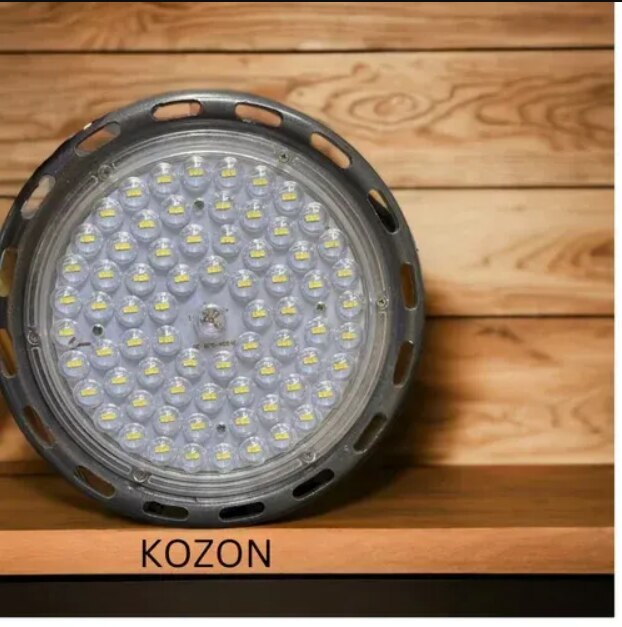
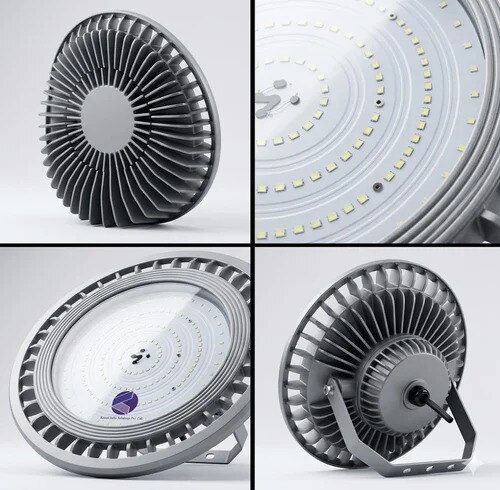 | LED High Bay Light 150 W Glass Modal High Bay Light ₹2400 Minimum order quantity: 5 Piece The Kozon India Solution Pvt Ltd UFO High Bay LED series is engineered for superior performance in demanding... View product → |
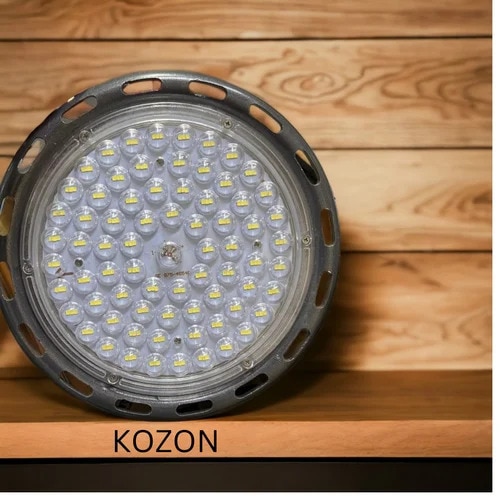 | LED High Bay Light ₹2150 Minimum order quantity: 10 Piece We are the Manufacturer of high bay light in all watage. View product → |
Frequently asked questions
Where does a 150W high bay fit in a large warehouse?
It fits open storage floors, loading areas and picking zones when photometry matches the ceiling height, spacing and visual task.
How can you prove the lighting level before installation?
Request the luminaire’s IES file and use a lighting simulation showing illuminance, uniformity, mounting height, spacing and calculation grid.
When does 150W beat 100W, 200W or 250W?
Choose 150W when its delivered lumens, beam distribution and spacing meet the target better than the competing wattages without excessive glare or wasted light.
What should you request from a Delhi NCR high bay supplier?
Request total input watts, delivered lumens, efficacy, beam angle, glare data, rated ambient temperature, warranty terms, test reports and installation guidance.
Related product
 | Hibay Lights ₹2354 Kozon 150W High Bay LED Light The Kozon 150W High Bay is a high-performance industrial lighting solution engineered for maximum durability and... View product → |
Keywords